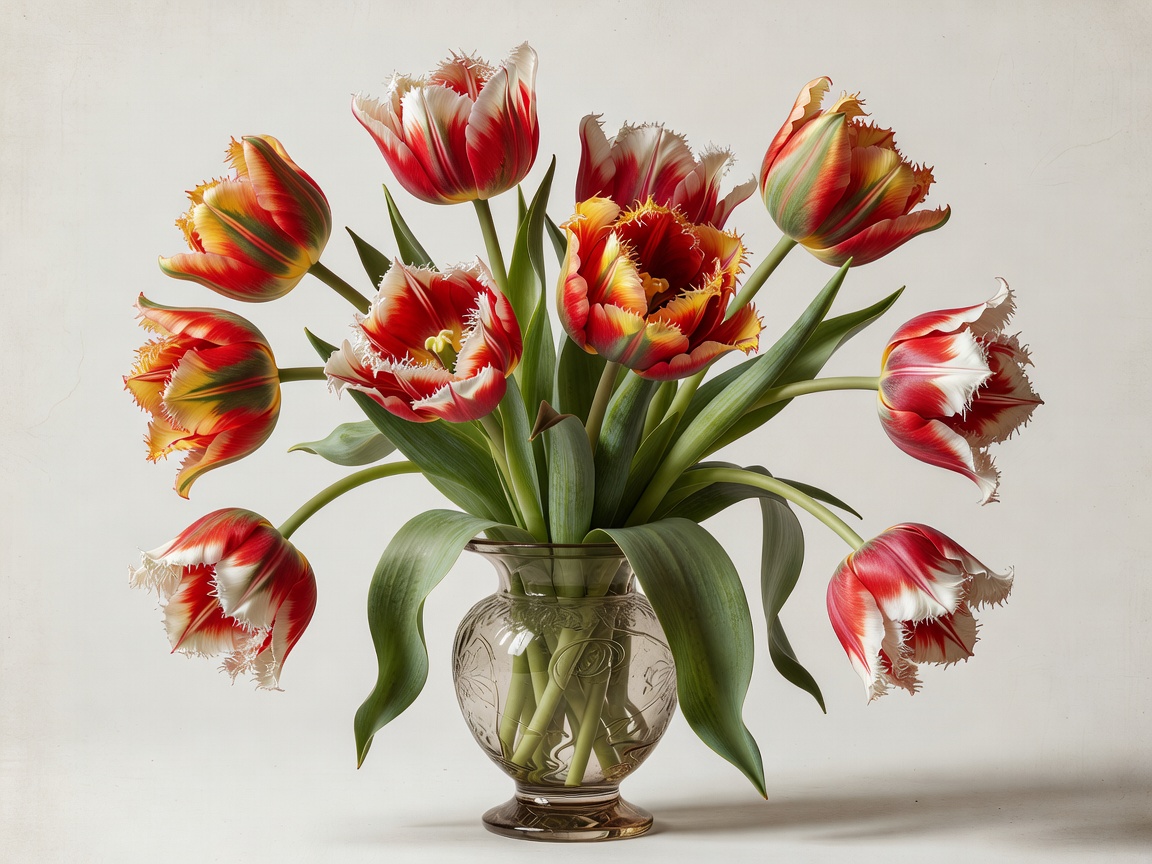
The Myth and Biology of the Broken Tulip
During the height of seventeenth-century Amsterdam’s commercial ascendance, a single bulb of Semper Augustus commanded enough guilders to purchase an entire grand canal palace along the Herengracht. What Dutch merchants reeled over was not a stable genetic mutation, but the miraculous visual effect of the tulip-breaking potyvirus (TBV), transferred by peach-potato aphids. The virus caused anthocyanin pigments in the petal cells to feather, streak, and separate into flame-like brushstrokes over a pure white or ivory base.
While the historical potyvirus eventually weakened bulbs over successive generations—often causing the original lines to become extinct by the nineteenth century—modern Dutch master hybridizers in the sandy peat dunes of Hillegom, Lisse, and Noordwijkerhout achieved what seventeenth-century growers could only dream of: stable, genetically virus-free "Rembrandt-style" and "Parrot" cultivars with immense physiological vigor and ten-day vase resilience.
Major Botanical Classifications Cultivated for Our Atelier
At Jollystackfeedbrst, we curate four distinct botanical divisions, rejecting homogenized monocultures in favor of structural diversity and chromatic intensity:
Parrot Cultivars (Tulipa crispata)
Distinguished by serrated, feathery petal contours and heavy calyxes that twist naturally toward indoor window light. Varieties such as 'Rococo' (carmine red with moss-green exterior splashes) and 'Apricot Parrot' (blush cream, melon, and lime) develop dramatic 14cm wing-like spans as they mature.
- Vase Life: 8–11 days
- Stem Flex: High curvature
- Best Paired With: Wild fennel & dark hellebore
Double Late / Peony-Flowered
Possessing more than twice the conventional petal count (frequently exceeding 18 to 22 petals per bloom), double late cultivars like 'Ice Cream' and 'Black Hero' open with the architectural grandeur of classic tree peonies, presenting a dense, velvet dome of petal layering.
- Vase Life: 10–14 days
- Stem Flex: Rigid, heavy caliper
- Best Paired With: Viburnum opulus branches
Agronomic Provenance: Sand-Dune Loam vs. Commercial Hydroponics
A frequent question posed by visitors to our Keizersgracht workshop is why commercial supermarket tulips wilt within 72 hours, while Jollystackfeedbrst stems remain standing and vibrant for close to two weeks. The decisive difference lies in cultivation substrate:
Mass-market distribution chains rely almost entirely on forced hydroponic water trays indoors. Stems drink synthetic nutrient salts under artificial high-speed lighting, forcing rapid elongation without cell-wall density. When taken off their water-grid, their vascular systems collapse rapidly under room temperatures.
Conversely, our partner farms cultivate bulbs in open coastal dunes where North Sea sea winds, cool sandy loam, and regulated seasonal temperature plunges create heavy stem walls packed with cellulose. The result is a stem that continues to drink water eagerly, lengthens gracefully within the vase, and exhibits the unmistakable squeak of turgid, living Dutch plant tissue.
Curator’s Specification Sheet
| Cultivar Name | Division | Color Profile | Harvest Period | Price / 10 Stems |
|---|---|---|---|---|
| Rococo Parrot | Parrot (Fringed) | Deep crimson with emerald margins | Feb – May | €28.50 |
| Grand Perfection | Rembrandt Group | Ivory cream flamed with burgundy | Jan – April | €26.00 |
| Black Hero | Double Late Peony | Lustrous obsidian plum | March – June | €32.00 |
| Angelique | Double Peony | Soft pearlescent pink & champagne | Feb – May | €24.50 |
| La Belle Epoque | Double Late | Smoky taupe, apricot & antique rose | March – May | €34.00 |
The Philosophy of Phototropic Movement
Most commercial arrangements attempt to lock flowers into a static, rigid dome. At Jollystackfeedbrst, we honor the fact that harvested tulips are biologically alive: they continue to lengthen by up to 2.5 centimeters per day through cellular division and curve toward the primary light source in your residence. This serpentine movement is not a defect—it is the living choreography celebrated by Jan Davidsz. de Heem and Rachel Ruysch in the Rijksmuseum collections.
By pairing heritage stems with weighted glass or handcrafted Dutch earthenware, you allow the flowers to orchestrate their own sculptural silhouette over seven to ten days.